Filter by
# Debug Box
/var/www/htdocs/pustaka-digital/lib/SearchEngine/SearchBiblioEngine.php:688 "Search Engine Debug 🔎 🪲"
Engine Type ⚙️: "SLiMS\SearchEngine\SearchBiblioEngine"
SQL ⚙️: array:2 [
  "count" => "select count(sb.biblio_id) from search_biblio as sb where sb.opac_hide=0 and ((match (sb.author) against (:author in boolean mode)))"
  "query" => "select sb.biblio_id, sb.title, sb.author, sb.topic, sb.image, sb.isbn_issn, sb.publisher, sb.publish_place, sb.publish_year, sb.labels, sb.input_date, sb.edition, sb.collation, sb.series_title, sb.call_number from search_biblio as sb where sb.opac_hide=0 and ((match (sb.author) against (:author in boolean mode))) order by sb.last_update desc limit 10 offset 0"
]
Bind Value ⚒️: array:1 [
  ":author" => "'+\"Breman, Jan\"'"
]

Social question in the twenty-first century: a global view
Want, disease, ignorance, squalor, and idleness: first recognized together in mid-nineteenth-century Europe, these are the focus of the Social Question. In 1942 William Beveridge called them the “giant evils” while diagnosing the crises produced by the emergence of industrial society. More recently, during the final quarter of the twentieth century, the global spread of neoliberal policies …
- Edition
- -
- ISBN/ISSN
- 9780520302402
- Collation
- xii, 266 pages : illustrations, maps ; 23 cm
- Series Title
- -
- Call Number
- 306.3 BRE s
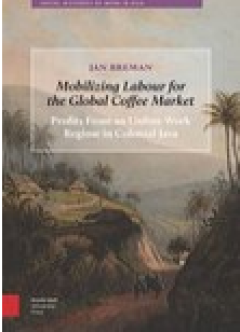
Mobilizing labour for the global cofee market
Coffee has been grown on Java for the commercial market since the early eighteenth century, when the Dutch East India Company began buying from peasant producers in the Priangan highlands. What began as a commercial transaction, however, soon became a system of compulsory production. This book shows how the Dutch East India Company mobilised land and labour, why they turned to force cultivation…
- Edition
- -
- ISBN/ISSN
- 9789048527144
- Collation
- 413p.: ill.
- Series Title
- -
- Call Number
- 950 BRE m
 Computer Science, Information & General Works
  Philosophy & Psychology
  Religion
  Social Sciences
  Language
  Pure Science
  Applied Sciences
  Art & Recreation
  Literature
  History & Geography