Filter by
Found 1 from your keywords: author="Davis, Howard, active ...
# Debug Box
/var/www/htdocs/pustaka-digital/lib/SearchEngine/SearchBiblioEngine.php:688 "Search Engine Debug 🔎 🪲"
Engine Type ⚙️: "SLiMS\SearchEngine\SearchBiblioEngine"
SQL ⚙️: array:2 [
  "count" => "select count(sb.biblio_id) from search_biblio as sb where sb.opac_hide=0 and ((match (sb.author) against (:author in boolean mode)))"
  "query" => "select sb.biblio_id, sb.title, sb.author, sb.topic, sb.image, sb.isbn_issn, sb.publisher, sb.publish_place, sb.publish_year, sb.labels, sb.input_date, sb.edition, sb.collation, sb.series_title, sb.call_number from search_biblio as sb where sb.opac_hide=0 and ((match (sb.author) against (:author in boolean mode))) order by sb.last_update desc limit 10 offset 0"
]
Bind Value ⚒️: array:1 [
  ":author" => "'+\"Davis, Howard, active 2010\"'"
]
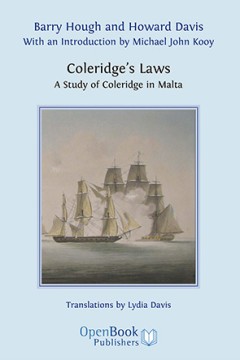
Coleridge's laws : a study of Coleridge in Malta
Samuel Taylor Coleridge is best known as a great poet and literary theorist, but for one, quite short, period of his life he held real political power—acting as Public Secretary to the British Civil Commissioner in Malta in 1805. This was a formative experience for Coleridge which he later identified as being one of the most instructive in his entire life. In this book, Barry Hough and Howard…
- Edition
- -
- ISBN/ISSN
- 9781906924140
- Collation
- xvi. :406 p.
- Series Title
- -
- Call Number
- 340.094585.
 Computer Science, Information & General Works
  Philosophy & Psychology
  Religion
  Social Sciences
  Language
  Pure Science
  Applied Sciences
  Art & Recreation
  Literature
  History & Geography