Filter by
# Debug Box
/var/www/htdocs/pustaka-digital/lib/SearchEngine/SearchBiblioEngine.php:688 "Search Engine Debug 🔎 🪲"
Engine Type ⚙️: "SLiMS\SearchEngine\SearchBiblioEngine"
SQL ⚙️: array:2 [
  "count" => "select count(sb.biblio_id) from search_biblio as sb where sb.opac_hide=0 and ((match (sb.author) against (:author in boolean mode)))"
  "query" => "select sb.biblio_id, sb.title, sb.author, sb.topic, sb.image, sb.isbn_issn, sb.publisher, sb.publish_place, sb.publish_year, sb.labels, sb.input_date, sb.edition, sb.collation, sb.series_title, sb.call_number from search_biblio as sb where sb.opac_hide=0 and ((match (sb.author) against (:author in boolean mode))) order by sb.last_update desc limit 10 offset 0"
]
Bind Value ⚒️: array:1 [
  ":author" => "'+\"Fry, Greg\"'"
]
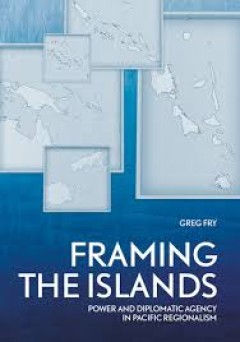
Framing the islands: power and diplomatic agency in Pacific regionalism
Since its origins in late eighteenth-century European thought, the idea of placing a regional frame around the Pacific islands has never been just an exercise in geographical mapping. This framing has always been a political exercise. Contending regional projects and visions have been part of a political struggle concerning how Pacific islanders should live their lives. Framing the Islands tell…
- Edition
- -
- ISBN/ISSN
- 9781760463151
- Collation
- xv, 399 pages : maps ; 24 cm
- Series Title
- ANU Press Pacific Series
- Call Number
- 327.2 FRY p

New Pacific diplomacy
Since 2009 there has been a fundamental shift in the way that the Pacific Island states engage with regional and world politics. The region has experienced, what Kiribati President Anote Tong has aptly called, a ‘paradigm shift’ in ideas about how Pacific diplomacy should be organised, and on what principles it should operate. Many leaders have called for a heightened Pacific voice in globa…
- Edition
- -
- ISBN/ISSN
- 9781925022810
- Collation
- xx, 305 pages : illustrations (some color), map ; 25 cm
- Series Title
- -
- Call Number
- 327.2 FRY n
 Computer Science, Information & General Works
  Philosophy & Psychology
  Religion
  Social Sciences
  Language
  Pure Science
  Applied Sciences
  Art & Recreation
  Literature
  History & Geography