Filter by
# Debug Box
/var/www/htdocs/pustaka-digital/lib/SearchEngine/SearchBiblioEngine.php:688 "Search Engine Debug 🔎 🪲"
Engine Type ⚙️: "SLiMS\SearchEngine\SearchBiblioEngine"
SQL ⚙️: array:2 [
  "count" => "select count(sb.biblio_id) from search_biblio as sb where sb.opac_hide=0 and ((match (sb.author) against (:author in boolean mode)))"
  "query" => "select sb.biblio_id, sb.title, sb.author, sb.topic, sb.image, sb.isbn_issn, sb.publisher, sb.publish_place, sb.publish_year, sb.labels, sb.input_date, sb.edition, sb.collation, sb.series_title, sb.call_number from search_biblio as sb where sb.opac_hide=0 and ((match (sb.author) against (:author in boolean mode))) order by sb.last_update desc limit 10 offset 0"
]
Bind Value ⚒️: array:1 [
  ":author" => "'+\"Graz, Jean-Christophe\"'"
]
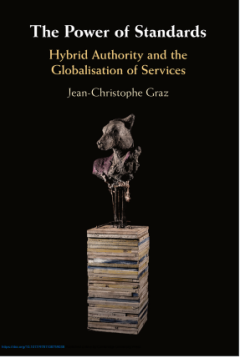
The Power of Standards
Standards often remain unseen, yet they play a fundamental part in the organisation of contemporary capitalism and society at large. What form of power do they epitomise? Why have they become so prominent? Are they set to be as important for the globalisation of services as for manufactured goods? Graz draws on international political economy and cognate fields to present strong theoretical arg…
- Edition
- -
- ISBN/ISSN
- 9781108759038
- Collation
- vii, 270p : ill
- Series Title
- -
- Call Number
- 658.562 JEA

The power of standards : hybrid authority and the globalisation of services
Standards often remain unseen, yet they play a fundamental part in the organisation of contemporary capitalism and society at large. What form of power do they epitomise? Why have they become so prominent? Are they set to be as important for the globalisation of services as for manufactured goods? Graz draws on international political economy and cognate fields to present strong theoretical arg…
- Edition
- -
- ISBN/ISSN
- 9781108759038
- Collation
- x, 258p. : ill.
- Series Title
- -
- Call Number
- 658.562 GRA p
 Computer Science, Information & General Works
  Philosophy & Psychology
  Religion
  Social Sciences
  Language
  Pure Science
  Applied Sciences
  Art & Recreation
  Literature
  History & Geography