Filter by
Found 1 from your keywords: author="Gurd, Sean"
# Debug Box
/var/www/htdocs/pustaka-digital/lib/SearchEngine/SearchBiblioEngine.php:688 "Search Engine Debug 🔎 🪲"
Engine Type ⚙️: "SLiMS\SearchEngine\SearchBiblioEngine"
SQL ⚙️: array:2 [
  "count" => "select count(sb.biblio_id) from search_biblio as sb where sb.opac_hide=0 and ((match (sb.author) against (:author in boolean mode)))"
  "query" => "select sb.biblio_id, sb.title, sb.author, sb.topic, sb.image, sb.isbn_issn, sb.publisher, sb.publish_place, sb.publish_year, sb.labels, sb.input_date, sb.edition, sb.collation, sb.series_title, sb.call_number from search_biblio as sb where sb.opac_hide=0 and ((match (sb.author) against (:author in boolean mode))) order by sb.last_update desc limit 10 offset 0"
]
Bind Value ⚒️: array:1 [
  ":author" => "'+\"Gurd, Sean\"'"
]
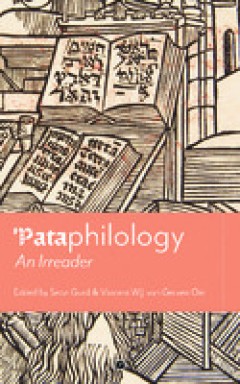
Pataphilology: an irreader
What do the bizzare etymologies of Jean-Pierre Brisset, made-up languages for literary fiction, The Dialectic of Enlightenment, Latin grammarians, Horace’s Epodes, and the Papyrus of Ani have in common? Absolutely nothing. Yet, taken together they provide an unusually coherent picture of a hitherto unacknowledged non-tradition of linguistic investigation. At these moments, particularly within…
- Edition
- -
- ISBN/ISSN
- 9781947447820
- Collation
- 240 p.; 22 cm.
- Series Title
- -
- Call Number
- 401 PAT p
 Computer Science, Information & General Works
  Philosophy & Psychology
  Religion
  Social Sciences
  Language
  Pure Science
  Applied Sciences
  Art & Recreation
  Literature
  History & Geography