Filter by
Found 1 from your keywords: author="Neville, Sarah"
# Debug Box
/var/www/htdocs/pustaka-digital/lib/SearchEngine/SearchBiblioEngine.php:688 "Search Engine Debug 🔎 🪲"
Engine Type ⚙️: "SLiMS\SearchEngine\SearchBiblioEngine"
SQL ⚙️: array:2 [
  "count" => "select count(sb.biblio_id) from search_biblio as sb where sb.opac_hide=0 and ((match (sb.author) against (:author in boolean mode)))"
  "query" => "select sb.biblio_id, sb.title, sb.author, sb.topic, sb.image, sb.isbn_issn, sb.publisher, sb.publish_place, sb.publish_year, sb.labels, sb.input_date, sb.edition, sb.collation, sb.series_title, sb.call_number from search_biblio as sb where sb.opac_hide=0 and ((match (sb.author) against (:author in boolean mode))) order by sb.last_update desc limit 10 offset 0"
]
Bind Value ⚒️: array:1 [
  ":author" => "'+\"Neville, Sarah\"'"
]
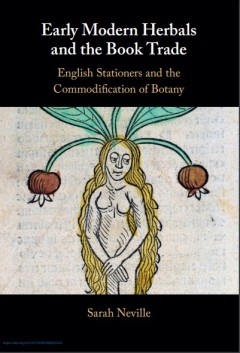
Early modern herbals and the book trade : English stationers and the commodif…
Between 1525 and 1640, a remarkable phenomenon occurred in the world of print: England saw the production of more than two dozen editions identified by their imprints or by contemporaries as 'herbals'. Sarah Neville explains how this genre grew from a series of tiny anonymous octavos to authoritative folio tomes with thousands of woodcuts, and how these curious works quickly became valuable com…
- Edition
- 8
- ISBN/ISSN
- 9781009031615
- Collation
- xvi; 290p; ill.
- Series Title
- -
- Call Number
- 615.3210942 EAR S
 Computer Science, Information & General Works
  Philosophy & Psychology
  Religion
  Social Sciences
  Language
  Pure Science
  Applied Sciences
  Art & Recreation
  Literature
  History & Geography