Filter by
Found 1 from your keywords: author="Sears, Laurie"
# Debug Box
/var/www/htdocs/pustaka-digital/lib/SearchEngine/SearchBiblioEngine.php:688 "Search Engine Debug 🔎 🪲"
Engine Type ⚙️: "SLiMS\SearchEngine\SearchBiblioEngine"
SQL ⚙️: array:2 [
  "count" => "select count(sb.biblio_id) from search_biblio as sb where sb.opac_hide=0 and ((match (sb.author) against (:author in boolean mode)))"
  "query" => "select sb.biblio_id, sb.title, sb.author, sb.topic, sb.image, sb.isbn_issn, sb.publisher, sb.publish_place, sb.publish_year, sb.labels, sb.input_date, sb.edition, sb.collation, sb.series_title, sb.call_number from search_biblio as sb where sb.opac_hide=0 and ((match (sb.author) against (:author in boolean mode))) order by sb.last_update desc limit 10 offset 0"
]
Bind Value ⚒️: array:1 [
  ":author" => "'+\"Sears, Laurie\"'"
]
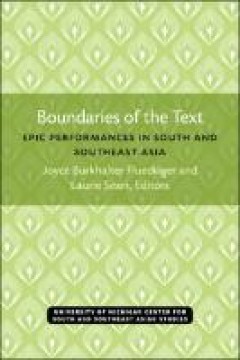
Boundaries of the text : epic performances in South and Southeast Asia
When the Mahabharata and Ramayana are performed in South and Southeast Asia, audiences may witness a variety of styles. A single performer may deliver a two-hour recitation, women may meet in informal singing groups, shaddow puppets may host an all-night play, or professional theaters may put on productions lasting thirty nights. Performances often celebrate ritual passages: births, deaths, mar…
- Edition
- -
- ISBN/ISSN
- 9780472901715
- Collation
- X, 161 p.
- Series Title
- Michigan Papers On South And Southeast Asia, 35
- Call Number
- 781.4 BOU b
 Computer Science, Information & General Works
  Philosophy & Psychology
  Religion
  Social Sciences
  Language
  Pure Science
  Applied Sciences
  Art & Recreation
  Literature
  History & Geography