Filter by
# Debug Box
/var/www/htdocs/pustaka-digital/lib/SearchEngine/SearchBiblioEngine.php:688 "Search Engine Debug 🔎 🪲"
Engine Type ⚙️: "SLiMS\SearchEngine\SearchBiblioEngine"
SQL ⚙️: array:2 [
  "count" => "select count(sb.biblio_id) from search_biblio as sb where sb.opac_hide=0 and ((match (sb.topic) against (:subject in boolean mode)))"
  "query" => "select sb.biblio_id, sb.title, sb.author, sb.topic, sb.image, sb.isbn_issn, sb.publisher, sb.publish_place, sb.publish_year, sb.labels, sb.input_date, sb.edition, sb.collation, sb.series_title, sb.call_number from search_biblio as sb where sb.opac_hide=0 and ((match (sb.topic) against (:subject in boolean mode))) order by sb.last_update desc limit 10 offset 0"
]
Bind Value ⚒️: array:1 [
  ":subject" => "'+\"Critical realism\"'"
]
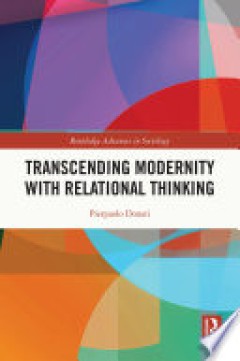
Transcending Modernity with Relational Thinking
This book explores the ways in which social relations are profoundly changing modern society, arguing that, constituting a reality of their own, social relations will ultimately lead to a new form of society: an aftermodern or relational society. Drawing on the thought of Simmel, it extends the idea that society consists essentially of social relations, in order to make sense of the operation o…
- Edition
- -
- ISBN/ISSN
- 9781000382679
- Collation
- 262p
- Series Title
- Routledge Advances in Sociology
- Call Number
- 302 DON

Thinking of Space Relationally : Critical Realism Beyond Relativism - A Manif…
Since the relational turn, scholars have combated methodological universalism, nationalism, and individualism in researching social-spatial transformations. Yet, when leaving the gaps between the traveling and local epistemic assumptions unattended, engaging relational spatial theories in empirical research may still reproduce established theoretical claims. Following the sociology of knowledge…
- Edition
- 8
- ISBN/ISSN
- 9783839455876
- Collation
- 282 p, ill.
- Series Title
- -
- Call Number
- 709.5115 GAO t
 Computer Science, Information & General Works
  Philosophy & Psychology
  Religion
  Social Sciences
  Language
  Pure Science
  Applied Sciences
  Art & Recreation
  Literature
  History & Geography