Filter by
Found 1 from your keywords: subject="Electronic digital co...
# Debug Box
/var/www/htdocs/pustaka-digital/lib/SearchEngine/SearchBiblioEngine.php:688 "Search Engine Debug 🔎 🪲"
Engine Type ⚙️: "SLiMS\SearchEngine\SearchBiblioEngine"
SQL ⚙️: array:2 [
  "count" => "select count(sb.biblio_id) from search_biblio as sb where sb.opac_hide=0 and ((match (sb.topic) against (:subject in boolean mode)))"
  "query" => "select sb.biblio_id, sb.title, sb.author, sb.topic, sb.image, sb.isbn_issn, sb.publisher, sb.publish_place, sb.publish_year, sb.labels, sb.input_date, sb.edition, sb.collation, sb.series_title, sb.call_number from search_biblio as sb where sb.opac_hide=0 and ((match (sb.topic) against (:subject in boolean mode))) order by sb.last_update desc limit 10 offset 0"
]
Bind Value ⚒️: array:1 [
  ":subject" => "'+\"Electronic digital computers\"'"
]
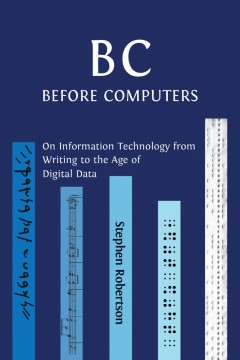
B C, Before Computers : on information technology from writing to the age of …
I found it a delight to read. The author is not trying to write yet another book on the history of computer developments but rather to show that those developments rely on a long history of humans creating solutions to problems that arose as they became more and more sophisticated in their treatment of concepts of information and its manipulation. In many ways it resembles a work of philosophy …
- Edition
- -
- ISBN/ISSN
- 9781800640313
- Collation
- 170p.: colour, ill.
- Series Title
- -
- Call Number
- 004.09 B r
 Computer Science, Information & General Works
  Philosophy & Psychology
  Religion
  Social Sciences
  Language
  Pure Science
  Applied Sciences
  Art & Recreation
  Literature
  History & Geography