Filter by
Found 1 from your keywords: subject="Fluids"
# Debug Box
/var/www/htdocs/pustaka-digital/lib/SearchEngine/SearchBiblioEngine.php:688 "Search Engine Debug 🔎 🪲"
Engine Type ⚙️: "SLiMS\SearchEngine\SearchBiblioEngine"
SQL ⚙️: array:2 [
  "count" => "select count(sb.biblio_id) from search_biblio as sb where sb.opac_hide=0 and ((match (sb.topic) against (:subject in boolean mode)))"
  "query" => "select sb.biblio_id, sb.title, sb.author, sb.topic, sb.image, sb.isbn_issn, sb.publisher, sb.publish_place, sb.publish_year, sb.labels, sb.input_date, sb.edition, sb.collation, sb.series_title, sb.call_number from search_biblio as sb where sb.opac_hide=0 and ((match (sb.topic) against (:subject in boolean mode))) order by sb.last_update desc limit 10 offset 0"
]
Bind Value ⚒️: array:1 [
  ":subject" => "'+\"Fluids\"'"
]
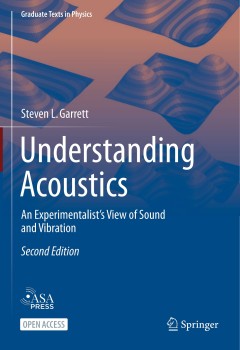
Understanding acoustics : an experimentalist's view of acoustics and vibration
This open access textbook, like Rayleigh’s classic Theory of Sound, focuses on experiments and on approximation techniques rather than mathematical rigor. The second edition has benefited from comments and corrections provided by many acousticians, in particular those who have used the first edition in undergraduate and graduate courses. For example, phasor notation has been added to clearly …
- Edition
- 2n edition
- ISBN/ISSN
- 9783030447878
- Collation
- xliii, 783p. : ill.
- Series Title
- -
- Call Number
- 620.21 GAR u
 Computer Science, Information & General Works
  Philosophy & Psychology
  Religion
  Social Sciences
  Language
  Pure Science
  Applied Sciences
  Art & Recreation
  Literature
  History & Geography