Filter by
# Debug Box
/var/www/htdocs/pustaka-digital/lib/SearchEngine/SearchBiblioEngine.php:688 "Search Engine Debug 🔎 🪲"
Engine Type ⚙️: "SLiMS\SearchEngine\SearchBiblioEngine"
SQL ⚙️: array:2 [
  "count" => "select count(sb.biblio_id) from search_biblio as sb where sb.opac_hide=0 and ((match (sb.topic) against (:subject in boolean mode)))"
  "query" => "select sb.biblio_id, sb.title, sb.author, sb.topic, sb.image, sb.isbn_issn, sb.publisher, sb.publish_place, sb.publish_year, sb.labels, sb.input_date, sb.edition, sb.collation, sb.series_title, sb.call_number from search_biblio as sb where sb.opac_hide=0 and ((match (sb.topic) against (:subject in boolean mode))) order by sb.last_update desc limit 10 offset 0"
]
Bind Value ⚒️: array:1 [
  ":subject" => "'+\"Grammar\"'"
]
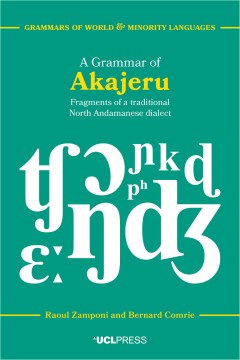
Grammar of Akajeru : fragments of a traditional north Andamanese dialect
A Grammar of Akajeru describes aspects of the grammatical system and lexicon of Akajeru, a traditional dialect of the North Andamanese language, as it was reportedly used around the beginning of the twentieth century. It is based primarily on the fragments of this variety provided by the British anthropologist Alfred R. Radcliffe-Brown and scattered among the published results of his anthropolo…
- Edition
- -
- ISBN/ISSN
- 9781800080935
- Collation
- xi, 170 p.
- Series Title
- -
- Call Number
- 495.9 AGR R

A grammar of the Eastern European Hasidic Hebrew tale
This volume constitutes the first reference grammar of the Hasidic Hebrew hagiographic tales composed in late nineteenth- and early twentieth-century Eastern Europe. It presents a thorough survey of Hasidic Hebrew orthography, morphology, syntax, and lexis illustrated with extensive examples.
- Edition
- -
- ISBN/ISSN
- 9789004281622
- Collation
- x, 450 p.
- Series Title
- Studies in Semitic languages and linguistics
- Call Number
- 492.47 KAH g
Morphosyntactic variation in medieval Celtic languages : corpus-based approaches
This book showcases the state of the art in corpus-based linguistic analysis of Celtic languages (specifically, Old/Middle Irish, Middle Welsh, and Cornish). It explores corpus approaches to morphosyntactic variation in the medieval Celtic languages and, for the first time, situates them in the broader field of computational and corpus linguistics by providing descriptions of tools for processi…
- Edition
- -
- ISBN/ISSN
- 9783110680744
- Collation
- xviii, 396 p. : ill.
- Series Title
- -
- Call Number
- 491.627 LAS m

Handbook of easy languages in Europe
The Handbook of Easy Languages in Europe describes what Easy Language is and how it is used in European countries. It demonstrates the great diversity of actors, instruments and outcomes related to Easy Language throughout Europe. All people, despite their limitations, have an equal right to information, inclusion, and social participation. This results in requirements for understandable langua…
- Edition
- -
- ISBN/ISSN
- 9783732991952
- Collation
- 623 p.
- Series Title
- -
- Call Number
- 400 LIN h

Ancient greek I : a 21st century approach
In this elementary textbook, Philip S. Peek draws on his twenty-five years of teaching experience to present the ancient Greek language in an imaginative and accessible way that promotes creativity, deep learning, and diversity. The course is built on three pillars: memory, analysis, and logic. Readers memorize the top 250 most frequently occurring ancient Greek words, the essential word end…
- Edition
- -
- ISBN/ISSN
- 9781800642560
- Collation
- xxiii, 610 p. : ill. ; 20.3 cm.
- Series Title
- -
- Call Number
- 488 PEE a
Meaning, life and culture : in conversation with Anna Wierzbicka
This book is dedicated to Anna Wierzbicka, one of the most influential and innovative linguists of her generation. Her work spans a number of disciplines, including anthropology, cultural psychology, cognitive science, philosophy and religious studies, as well as her home base of linguistics. She is best known for the Natural Semantic Metalanguage (NSM) approach to meaning—a versatile tool fo…
- Edition
- -
- ISBN/ISSN
- 9781760463939
- Collation
- XVIII, 515 p.
- Series Title
- -
- Call Number
- 801.4 MEA m

Easy Language – plain language – easy language plus : balancing comprehen…
This book shows how accessible communication, and especially easy-to-understand languages, should be designed in order to become instruments of inclusion. It examines two well-established easy-to-understand varieties: Easy Language and Plain Language, and shows that they have complementary profiles with respect to four central qualities: comprehensibility, perceptibility, acceptability and stig…
- Edition
- Vol. 3
- ISBN/ISSN
- 9783732992997
- Collation
- 301 p.
- Series Title
- Easy – Plain – Accessible, 3
- Call Number
- 428.2 MAA e

Signgram blueprint. A guide to sign language grammar writing
Current grammatical knowledge about sign languages is fragmentary and of varying reliability and is scattered in scientific publications where the description is often intertwined with the analysis. Comprehensive grammars are rare. This work is an innovative tool for the grammar writer: a full-fledged guide to describing all components of the grammars of sign languages in a thorough and systema…
- Edition
- -
- ISBN/ISSN
- 9781501511806
- Collation
- 824 p.; 22 cm.
- Series Title
- De Gruyter Reference
- Call Number
- 419 SIG s
The lexeme indescriptive and theoretical morphology
After being dominant during about a century since its invention by Baudouin de Courtenay at the end of the nineteenth century, morpheme is more and more replaced by lexeme in contemporary descriptive and theoretical morphology. The notion of a lexeme is usually associated with the work of P. H. Matthews (1972, 1974), who characterizes it as a lexical entity abstracting over individual inflected…
- Edition
- -
- ISBN/ISSN
- 9783961101108
- Collation
- -
- Series Title
- Empirically Oriented Theoretical Morphology and Syntax, 4
- Call Number
- 415.92 LEX l

Reconstructing syntax
During several decades, syntactic reconstruction has been more or less regarded as a bootless and an unsuccessful venture, not least due to the heavy criticism in the 1970s from scholars like Watkins, Jeffers, Lightfoot, etc. This fallacious view culminated in Lightfoot’s (2002: 625) conclusion: “[i]f somebody thinks that they can reconstruct grammars more successfully and in more widesprea…
- Edition
- -
- ISBN/ISSN
- 9789004392007
- Collation
- xii, 378p. : ill.
- Series Title
- -
- Call Number
- 415 REC r
 Computer Science, Information & General Works
  Philosophy & Psychology
  Religion
  Social Sciences
  Language
  Pure Science
  Applied Sciences
  Art & Recreation
  Literature
  History & Geography