Filter by
Found 1 from your keywords: subject="Internet--Psychologic...
# Debug Box
/var/www/htdocs/pustaka-digital/lib/SearchEngine/SearchBiblioEngine.php:688 "Search Engine Debug 🔎 🪲"
Engine Type ⚙️: "SLiMS\SearchEngine\SearchBiblioEngine"
SQL ⚙️: array:2 [
  "count" => "select count(sb.biblio_id) from search_biblio as sb where sb.opac_hide=0 and ((match (sb.topic) against (:subject in boolean mode)))"
  "query" => "select sb.biblio_id, sb.title, sb.author, sb.topic, sb.image, sb.isbn_issn, sb.publisher, sb.publish_place, sb.publish_year, sb.labels, sb.input_date, sb.edition, sb.collation, sb.series_title, sb.call_number from search_biblio as sb where sb.opac_hide=0 and ((match (sb.topic) against (:subject in boolean mode))) order by sb.last_update desc limit 10 offset 0"
]
Bind Value ⚒️: array:1 [
  ":subject" => "'+\"Internet--Psychological aspects\"'"
]
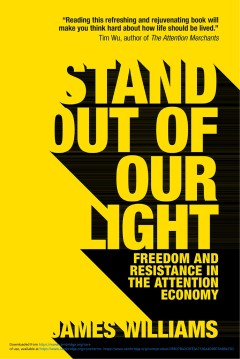
Stand out of our light : freedom and resistance in the attention economy
Former Google advertising strategist, now Oxford-trained philosopher James Williams launches a plea to society and to the tech industry to help ensure that the technology we all carry with us every day does not distract us from pursuing our true goals in life. As information becomes ever more plentiful, the resource that is becoming more scarce is our attention. In this 'attention economy', we …
- Edition
- -
- ISBN/ISSN
- 9781108453004
- Collation
- xv, 134p. : ill.
- Series Title
- -
- Call Number
- 153.733 WIL s
 Computer Science, Information & General Works
  Philosophy & Psychology
  Religion
  Social Sciences
  Language
  Pure Science
  Applied Sciences
  Art & Recreation
  Literature
  History & Geography