Filter by
Found 1 from your keywords: subject="Liberty--Biblical tea...
# Debug Box
/var/www/htdocs/pustaka-digital/lib/SearchEngine/SearchBiblioEngine.php:688 "Search Engine Debug 🔎 🪲"
Engine Type ⚙️: "SLiMS\SearchEngine\SearchBiblioEngine"
SQL ⚙️: array:2 [
  "count" => "select count(sb.biblio_id) from search_biblio as sb where sb.opac_hide=0 and ((match (sb.topic) against (:subject in boolean mode)))"
  "query" => "select sb.biblio_id, sb.title, sb.author, sb.topic, sb.image, sb.isbn_issn, sb.publisher, sb.publish_place, sb.publish_year, sb.labels, sb.input_date, sb.edition, sb.collation, sb.series_title, sb.call_number from search_biblio as sb where sb.opac_hide=0 and ((match (sb.topic) against (:subject in boolean mode))) order by sb.last_update desc limit 10 offset 0"
]
Bind Value ⚒️: array:1 [
  ":subject" => "'+\"Liberty--Biblical teaching\"'"
]
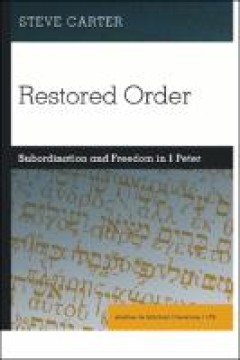
Restored order : subordination and freedom in 1 Peter
The concept of subordination plays a prominent role in the paranesis of 1 Peter, and it appears too in the context of Christ’s victory over the cosmic powers. It seems to presuppose some kind of given natural and social order in which people must live in their allotted place. But the author also sees his readers’ subordination as conditioned by their status as free people, which he expounds…
- Edition
- Edisi 9
- ISBN/ISSN
- 9781433192425
- Collation
- xi; 338 p.
- Series Title
- -
- Call Number
- 227.9206 CAR r
 Computer Science, Information & General Works
  Philosophy & Psychology
  Religion
  Social Sciences
  Language
  Pure Science
  Applied Sciences
  Art & Recreation
  Literature
  History & Geography