Filter by
# Debug Box
/var/www/htdocs/pustaka-digital/lib/SearchEngine/SearchBiblioEngine.php:688 "Search Engine Debug 🔎 🪲"
Engine Type ⚙️: "SLiMS\SearchEngine\SearchBiblioEngine"
SQL ⚙️: array:2 [
  "count" => "select count(sb.biblio_id) from search_biblio as sb where sb.opac_hide=0 and ((match (sb.topic) against (:subject in boolean mode)))"
  "query" => "select sb.biblio_id, sb.title, sb.author, sb.topic, sb.image, sb.isbn_issn, sb.publisher, sb.publish_place, sb.publish_year, sb.labels, sb.input_date, sb.edition, sb.collation, sb.series_title, sb.call_number from search_biblio as sb where sb.opac_hide=0 and ((match (sb.topic) against (:subject in boolean mode))) order by sb.last_update desc limit 10 offset 0"
]
Bind Value ⚒️: array:1 [
  ":subject" => "'+\"Libraries\"'"
]

Designing libraries for the 21st century
The 21st century has seen a transformational shift in the design of college and research libraries, one focused more on user experience and engagement than on collections. Dramatic changes in library design have been driven by changes in the core functions of universities and colleges: the reliance on digital tools and content, integration of technologies into pedagogy and research, and emphasi…
- Edition
- -
- ISBN/ISSN
- 9780838936764
- Collation
- xviii, 462 hlm. : ilustrasi berwarna ; 28 cm.
- Series Title
- -
- Call Number
- 727.8 DES d

Rethinking institutional repositories: innovations in management, collections…
Over the past two decades, institutional repositories (IRs) have become commonplace in academic libraries. Library workers have grown accustomed to making the case for why their institution needs an IR, but the more fundamental question of “how” remains: How should libraries use their IRs most effectively to benefit their institutions and communities?\r\n \r\nRethinking Institutional Reposi…
- Edition
- -
- ISBN/ISSN
- 9798892555432
- Collation
- xi, 259 hlm. ; 23 cm.
- Series Title
- -
- Call Number
- 025.84 RET r

Scholarly communication librarianship and open knowledge
Scholarly Communication Librarianship and Open Knowledge, edited by Maria Bonn, Josh Bolick, and Will Cross, is an openly licensed textbook, packed with foundational knowledge, as well as practical lessons in open data, open access, and open education; it also includes short case studies from those working in the field. Readers hear from nearly 80 scholarly communications (scholcomm) practition…
- Edition
- -
- ISBN/ISSN
- 9780838939901
- Collation
- xv, 528 hlm. : ilustrasi ; 28 cm.
- Series Title
- -
- Call Number
- 025.04 BON s

Corporate memory : records and information management in the knowledge age
Corporate memory' is the body of information that an organization needs to keep for re-use. It is the active and historical information that an organization has that is worth sharing, managing and preserving to enable it to function effectively. This book is aimed at records managers and archivists, who are responsible for maintaining and managing information within an organization. It describe…
- Edition
- 32
- ISBN/ISSN
- 9783598440113
- Collation
- xi, 156 p
- Series Title
- -
- Call Number
- 658.4038 KEN c
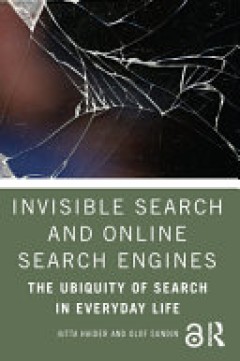
Invisible search and online search engines : the ubiquity of search in everyd…
Invisible Search and Online Search Engines considers the use of search engines in contemporary everyday life and the challenges this poses for media and information literacy. Looking for mediated information is mostly done online and arbitrated by the various tools and devices that people carry with them on a daily basis. Because of this, search engines have a significant impact on the structur…
- Edition
- -
- ISBN/ISSN
- 9781138328617
- Collation
- -
- Series Title
- -
- Call Number
- 025.0425 HAI

The internationalization of the academic library
The Internationalization of the Academic Library presents a theoretically informed, empirically grounded analysis of the process of academic library internationalization. Drawing on interviews with library personnel from around the world, Lombard analyzes internationalization at the departmental level of an academic library. Demonstrating that college and library personnel have positive intenti…
- Edition
- -
- ISBN/ISSN
- 9781003128878
- Collation
- ix + 137 p
- Series Title
- -
- Call Number
- 027.7 LOM i
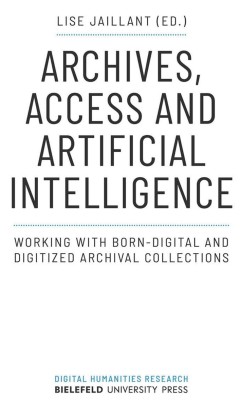
Archives, access and artificial intelligence
Digital archives are transforming the Humanities and the Sciences. Digitized collections of newspapers and books have pushed scholars to develop new, data-rich methods. Born-digital archives are now better preserved and managed thanks to the development of open-access and commercial software. Digital Humanities have moved from the fringe to the center of academia. Yet, the path from the apprais…
- Edition
- -
- ISBN/ISSN
- 9783839455845
- Collation
- 221p : ill.
- Series Title
- -
- Call Number
- 000 ARC a

Invisible search and online search engines
Invisible Search and Online Search Engines considers the use of search engines in contemporary everyday life and the challenges this poses for media and information literacy. Looking for mediated information is mostly done online and arbitrated by the various tools and devices that people carry with them on a daily basis. Because of this, search engines have a significant impact on the structur…
- Edition
- -
- ISBN/ISSN
- 9780429448546
- Collation
- viii, 151 p. : ind. ; 24 cm
- Series Title
- -
- Call Number
- 025.0425 HAI i
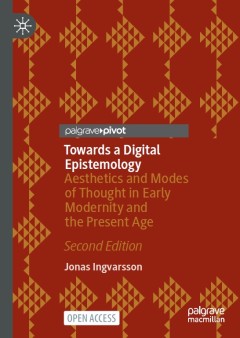
Towards a digital epistemology : aesthetics and modes of thought in early mod…
This Open Access book explores the concept of digital epistemology. In this context, the digital will not be understood as merely something that is linked to specific tools and objects, but rather as different modes of thought. For example, the digital within the humanities is not just databases and big data, topic modelling and speculative visualizations; nor are the objects limited to compute…
- Edition
- -
- ISBN/ISSN
- 9783030787240
- Collation
- xvi, 136p. : ill.
- Series Title
- -
- Call Number
- 001.0285 ING t
Libraries, archives and museums as democratic spaces in a digital age
Libraries, archives and museums have traditionally been a part of the public sphere's infrastructure. They have been so by providing public access to culture and knowledge, by being agents for enlightenment and by being public meeting places in their communities. Digitization and globalization poses new challenges in relation to upholding a sustainable public sphere. Can libraries, archives and…
- Edition
- -
- ISBN/ISSN
- 9783110636628
- Collation
- VIII, 370 p.
- Series Title
- Current Topics in Library and Information Practice
- Call Number
- 021.8 LIB l
 Computer Science, Information & General Works
  Philosophy & Psychology
  Religion
  Social Sciences
  Language
  Pure Science
  Applied Sciences
  Art & Recreation
  Literature
  History & Geography