Filter by
# Debug Box
/var/www/htdocs/pustaka-digital/lib/SearchEngine/SearchBiblioEngine.php:688 "Search Engine Debug 🔎 🪲"
Engine Type ⚙️: "SLiMS\SearchEngine\SearchBiblioEngine"
SQL ⚙️: array:2 [
  "count" => "select count(sb.biblio_id) from search_biblio as sb where sb.opac_hide=0 and ((match (sb.topic) against (:subject in boolean mode)))"
  "query" => "select sb.biblio_id, sb.title, sb.author, sb.topic, sb.image, sb.isbn_issn, sb.publisher, sb.publish_place, sb.publish_year, sb.labels, sb.input_date, sb.edition, sb.collation, sb.series_title, sb.call_number from search_biblio as sb where sb.opac_hide=0 and ((match (sb.topic) against (:subject in boolean mode))) order by sb.last_update desc limit 10 offset 0"
]
Bind Value ⚒️: array:1 [
  ":subject" => "'+\"Middle class\"'"
]

China, Surpassing the "Middle Income Trap"
This open access book explores one of the most fiercely debated issues in China: if and how China will surpass the middle income trap that has plagued many developing countries for years. This book gives readers a clear picture of China today and acts as a reference for other developing countries. China is facing many setbacks and experiencing an economic slowdown in recent years due to some…
- Edition
- -
- ISBN/ISSN
- 9789811565403
- Collation
- xix, 218p. : ill.
- Series Title
- -
- Call Number
- 330.0095 ZHO c
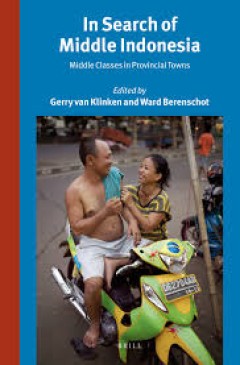
In Search of Middle Indonesia : middle classes in provincial towns
The middle classes of Indonesia’s provincial towns are not particularly rich yet nationally influential. This book examines them ethnographically. Rather than a market-friendly, liberal middle class, it finds a conservative petty bourgeoisie just out of poverty and skilled at politics. Please note that Sylvia Tidey's article (pp. 89-110) will only be available in the print edition of this book
- Edition
- -
- ISBN/ISSN
- 9789004263437
- Collation
- xiii, 239 p.; 22 cm.
- Series Title
- (Verhandelingen van het Koninklijk Instituut voor Taal-, Land en Volkenkunde, ISSN 1572-1892 ; volume 292) (Power and place in Southeast Asia ; volume 4)
- Call Number
- 305.5’509598 INS i
 Computer Science, Information & General Works
  Philosophy & Psychology
  Religion
  Social Sciences
  Language
  Pure Science
  Applied Sciences
  Art & Recreation
  Literature
  History & Geography