Filter by
Found 1 from your keywords: subject="Morphemics"
# Debug Box
/var/www/htdocs/pustaka-digital/lib/SearchEngine/SearchBiblioEngine.php:688 "Search Engine Debug 🔎 🪲"
Engine Type ⚙️: "SLiMS\SearchEngine\SearchBiblioEngine"
SQL ⚙️: array:2 [
  "count" => "select count(sb.biblio_id) from search_biblio as sb where sb.opac_hide=0 and ((match (sb.topic) against (:subject in boolean mode)))"
  "query" => "select sb.biblio_id, sb.title, sb.author, sb.topic, sb.image, sb.isbn_issn, sb.publisher, sb.publish_place, sb.publish_year, sb.labels, sb.input_date, sb.edition, sb.collation, sb.series_title, sb.call_number from search_biblio as sb where sb.opac_hide=0 and ((match (sb.topic) against (:subject in boolean mode))) order by sb.last_update desc limit 10 offset 0"
]
Bind Value ⚒️: array:1 [
  ":subject" => "'+\"Morphemics\"'"
]
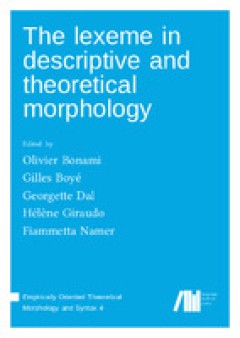
The lexeme indescriptive and theoretical morphology
After being dominant during about a century since its invention by Baudouin de Courtenay at the end of the nineteenth century, morpheme is more and more replaced by lexeme in contemporary descriptive and theoretical morphology. The notion of a lexeme is usually associated with the work of P. H. Matthews (1972, 1974), who characterizes it as a lexical entity abstracting over individual inflected…
- Edition
- -
- ISBN/ISSN
- 9783961101108
- Collation
- -
- Series Title
- Empirically Oriented Theoretical Morphology and Syntax, 4
- Call Number
- 415.92 LEX l
 Computer Science, Information & General Works
  Philosophy & Psychology
  Religion
  Social Sciences
  Language
  Pure Science
  Applied Sciences
  Art & Recreation
  Literature
  History & Geography