Filter by
# Debug Box
/var/www/htdocs/pustaka-digital/lib/SearchEngine/SearchBiblioEngine.php:688 "Search Engine Debug 🔎 🪲"
Engine Type ⚙️: "SLiMS\SearchEngine\SearchBiblioEngine"
SQL ⚙️: array:2 [
  "count" => "select count(sb.biblio_id) from search_biblio as sb where sb.opac_hide=0 and ((match (sb.topic) against (:subject in boolean mode)))"
  "query" => "select sb.biblio_id, sb.title, sb.author, sb.topic, sb.image, sb.isbn_issn, sb.publisher, sb.publish_place, sb.publish_year, sb.labels, sb.input_date, sb.edition, sb.collation, sb.series_title, sb.call_number from search_biblio as sb where sb.opac_hide=0 and ((match (sb.topic) against (:subject in boolean mode))) order by sb.last_update desc limit 10 offset 0"
]
Bind Value ⚒️: array:1 [
  ":subject" => "'+\"Musical perception\"'"
]

The Illiterate Listener : On Music Cognition, Musicality and Methodology
We have known for some time that babies possess a keen perceptual sensitivity for the melodic, rhythmic and dynamic aspects of speech and music: aspects that linguists are inclined to categorize under the term ‘prosody’, but which are in fact the building blocks of music. Only much later in a child’s development does he make use of this ‘musical prosody’, for instance in delineating a…
- Edition
- -
- ISBN/ISSN
- 9789048526987
- Collation
- 25p.: ill.
- Series Title
- -
- Call Number
- 781.11 HEN t
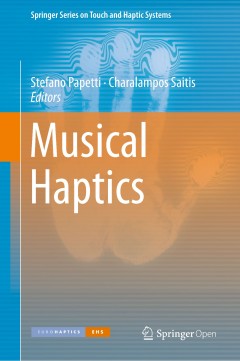
Musical haptics
This Open Access book offers an original interdisciplinary overview of the role of haptic feedback in musical interaction. Divided into two parts, part I examines the tactile aspects of music performance and perception, discussing how they affect user experience and performance in terms of usability, functionality and perceived quality of musical instruments. Part II presents engineering, compu…
- Edition
- -
- ISBN/ISSN
- 9783319583167
- Collation
- xv, 285p. : ill.
- Series Title
- -
- Call Number
- 004.77 MUS m
 Computer Science, Information & General Works
  Philosophy & Psychology
  Religion
  Social Sciences
  Language
  Pure Science
  Applied Sciences
  Art & Recreation
  Literature
  History & Geography