Filter by
Found 2 from your keywords: subject="Rape"
# Debug Box
/var/www/htdocs/pustaka-digital/lib/SearchEngine/SearchBiblioEngine.php:688 "Search Engine Debug 🔎 🪲"
Engine Type ⚙️: "SLiMS\SearchEngine\SearchBiblioEngine"
SQL ⚙️: array:2 [
  "count" => "select count(sb.biblio_id) from search_biblio as sb where sb.opac_hide=0 and ((match (sb.topic) against (:subject in boolean mode)))"
  "query" => "select sb.biblio_id, sb.title, sb.author, sb.topic, sb.image, sb.isbn_issn, sb.publisher, sb.publish_place, sb.publish_year, sb.labels, sb.input_date, sb.edition, sb.collation, sb.series_title, sb.call_number from search_biblio as sb where sb.opac_hide=0 and ((match (sb.topic) against (:subject in boolean mode))) order by sb.last_update desc limit 10 offset 0"
]
Bind Value ⚒️: array:1 [
  ":subject" => "'+\"Rape\"'"
]
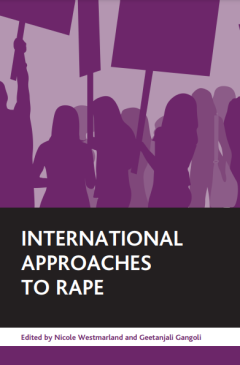
International approaches to rape
By introducing readers to national perspectives of issues relating to rape, the book presents a comparative approach which highlights similarities and differences between countries, contexts, laws, key issues and policies and interventions.
- Edition
- -
- ISBN/ISSN
- 9781847426222
- Collation
- 238p.
- Series Title
- -
- Call Number
- 364.1532 NIC i

Dismantling rape culture : the peacebuilding power of ‘Me Too’
This book analyses rape culture through the lens of the ‘me too’ era. Drawing feminist theory into conversation with peace studies and improvisation theory, it advocates for peace- building opportunities to transform culture and for the improvisatory resources of ‘culture- jamming’ as a mechanism to dismantle rape culture. The book’s key argument is that cultural attitudes and behavio…
- Edition
- -
- ISBN/ISSN
- 9781003124290
- Collation
- X, 209 p.
- Series Title
- Interdisciplinary Research in Gender
- Call Number
- 305.42 NIC d
 Computer Science, Information & General Works
  Philosophy & Psychology
  Religion
  Social Sciences
  Language
  Pure Science
  Applied Sciences
  Art & Recreation
  Literature
  History & Geography