Filter by
# Debug Box
/var/www/htdocs/pustaka-digital/lib/SearchEngine/SearchBiblioEngine.php:688 "Search Engine Debug 🔎 🪲"
Engine Type ⚙️: "SLiMS\SearchEngine\SearchBiblioEngine"
SQL ⚙️: array:2 [
  "count" => "select count(sb.biblio_id) from search_biblio as sb where sb.opac_hide=0 and ((match (sb.topic) against (:subject in boolean mode)))"
  "query" => "select sb.biblio_id, sb.title, sb.author, sb.topic, sb.image, sb.isbn_issn, sb.publisher, sb.publish_place, sb.publish_year, sb.labels, sb.input_date, sb.edition, sb.collation, sb.series_title, sb.call_number from search_biblio as sb where sb.opac_hide=0 and ((match (sb.topic) against (:subject in boolean mode))) order by sb.last_update desc limit 10 offset 0"
]
Bind Value ⚒️: array:1 [
  ":subject" => "'+\"Sintaksis\"'"
]

Syntax of Dutch: adjectives and adjective phrases
The Syntax of Dutch will be published in at least seven volumes in the period 2012-2016 and aims at presenting a synthesis of the currently available syntactic knowledge of Dutch. It is primarily concerned with language description and not with linguistic theory, and provides support to all researchers interested in matters relating to the syntax of Dutch, including advanced students of languag…
- Edition
- -
- ISBN/ISSN
- 9789089645494
- Collation
- -
- Series Title
- Comprehensive Grammar Resources, 3
- Call Number
- 439.315 BRO s
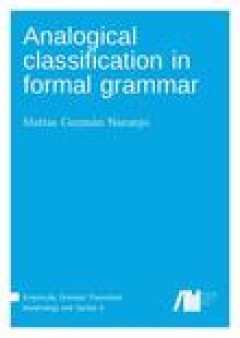
Analogical classification in formal grammar
The organization of the lexicon, and especially the relations between groups of lexemes is a strongly debated topic in linguistics. Some authors have insisted on the lack of any structure of the lexicon. In this vein, Di Sciullo & Williams (1987: 3) claim that “[t]he lexicon is like a prison – it contains only the lawless, and the only thing that its inmates have in commonis lawlessness”.…
- Edition
- -
- ISBN/ISSN
- 9783961101870
- Collation
- -
- Series Title
- -
- Call Number
- 425 NAR a
 Computer Science, Information & General Works
  Philosophy & Psychology
  Religion
  Social Sciences
  Language
  Pure Science
  Applied Sciences
  Art & Recreation
  Literature
  History & Geography