Filter by
Found 1 from your keywords: subject="Termanu language"
# Debug Box
/var/www/htdocs/pustaka-digital/lib/SearchEngine/SearchBiblioEngine.php:688 "Search Engine Debug 🔎 🪲"
Engine Type ⚙️: "SLiMS\SearchEngine\SearchBiblioEngine"
SQL ⚙️: array:2 [
  "count" => "select count(sb.biblio_id) from search_biblio as sb where sb.opac_hide=0 and ((match (sb.topic) against (:subject in boolean mode)))"
  "query" => "select sb.biblio_id, sb.title, sb.author, sb.topic, sb.image, sb.isbn_issn, sb.publisher, sb.publish_place, sb.publish_year, sb.labels, sb.input_date, sb.edition, sb.collation, sb.series_title, sb.call_number from search_biblio as sb where sb.opac_hide=0 and ((match (sb.topic) against (:subject in boolean mode))) order by sb.last_update desc limit 10 offset 0"
]
Bind Value ⚒️: array:1 [
  ":subject" => "'+\"Termanu language\"'"
]
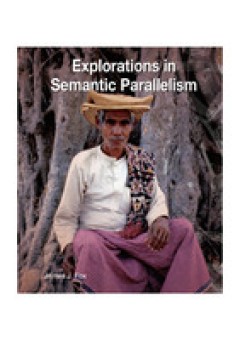
Explorations in Semantic Parallelism
Since 1965, when I frst began to record and attempt to understand the ritual poetry of the Rotenese, the study of semantic parallelism has been a major focus of my research. My chief concern has been with the semantics of canonical parallelism. In my view, the study of parallelism and particularly the study of canonical parallelism is no minor subject but is, in fact, a matter of central theore…
- Edition
- -
- ISBN/ISSN
- 9781925021066
- Collation
- xi, 433p. : ill
- Series Title
- -
- Call Number
- 401.43 JAM e
 Computer Science, Information & General Works
  Philosophy & Psychology
  Religion
  Social Sciences
  Language
  Pure Science
  Applied Sciences
  Art & Recreation
  Literature
  History & Geography