Filter by
Found 1 from your keywords: subject="Writing System, Alpha...
# Debug Box
/var/www/htdocs/pustaka-digital/lib/SearchEngine/SearchBiblioEngine.php:688 "Search Engine Debug 🔎 🪲"
Engine Type ⚙️: "SLiMS\SearchEngine\SearchBiblioEngine"
SQL ⚙️: array:2 [
  "count" => "select count(sb.biblio_id) from search_biblio as sb where sb.opac_hide=0 and ((match (sb.topic) against (:subject in boolean mode)))"
  "query" => "select sb.biblio_id, sb.title, sb.author, sb.topic, sb.image, sb.isbn_issn, sb.publisher, sb.publish_place, sb.publish_year, sb.labels, sb.input_date, sb.edition, sb.collation, sb.series_title, sb.call_number from search_biblio as sb where sb.opac_hide=0 and ((match (sb.topic) against (:subject in boolean mode))) order by sb.last_update desc limit 10 offset 0"
]
Bind Value ⚒️: array:1 [
  ":subject" => "'+\"Writing System, Alphabets\"'"
]
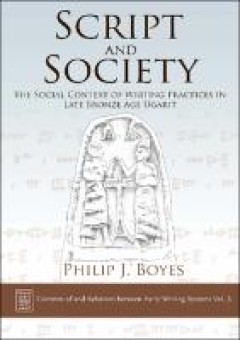
Script and society : the social context of writing practices in late Bronze A…
By the 13th century BC, the Syrian city of Ugarit hosted an extremely diverse range of writing practices. As well as two main scripts – alphabetic and logographic cuneiform - the site has also produced inscriptions in a wide range of scripts and languages, including Hurrian, Sumerian, Hittite, Egyptian hieroglyphs, Luwian hieroglyphs and Cypro-Minoan. This variety in script and language is ac…
- Edition
- -
- ISBN/ISSN
- 9781789255843
- Collation
- viii, 308 p . : ill.
- Series Title
- -
- Call Number
- 411.70939433 BOY s
 Computer Science, Information & General Works
  Philosophy & Psychology
  Religion
  Social Sciences
  Language
  Pure Science
  Applied Sciences
  Art & Recreation
  Literature
  History & Geography