Filter by
# Debug Box
/var/www/htdocs/pustaka-digital/lib/SearchEngine/SearchBiblioEngine.php:688 "Search Engine Debug 🔎 🪲"
Engine Type ⚙️: "SLiMS\SearchEngine\SearchBiblioEngine"
SQL ⚙️: array:2 [
  "count" => "select count(sb.biblio_id) from search_biblio as sb where sb.opac_hide=0 and ((match (sb.topic) against (:subject in boolean mode)))"
  "query" => "select sb.biblio_id, sb.title, sb.author, sb.topic, sb.image, sb.isbn_issn, sb.publisher, sb.publish_place, sb.publish_year, sb.labels, sb.input_date, sb.edition, sb.collation, sb.series_title, sb.call_number from search_biblio as sb where sb.opac_hide=0 and ((match (sb.topic) against (:subject in boolean mode))) order by sb.last_update desc limit 10 offset 0"
]
Bind Value ⚒️: array:1 [
  ":subject" => "'+\"cultural criticism\"'"
]
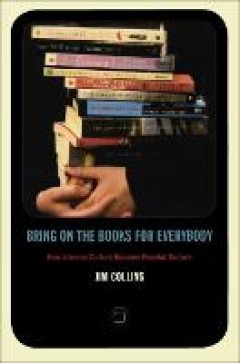
Bring on the books for everybody : how literary culture became popular culture
Bring on the Books for Everybody is an engaging assessment of the robust popular literary culture that has developed in the United States during the past two decades. Jim Collins describes how a once solitary and print-based experience has become an exuberantly social activity, enjoyed as much on the screen as on the page. Fueled by Oprah’s Book Club, Miramax film adaptations, superstore book…
- Edition
- -
- ISBN/ISSN
- 9780822391975
- Collation
- -
- Series Title
- -
- Call Number
- 306.0973 COL

The Cultural Politics of the New American Studies
In The Cultural Politics of the New American Studies, leading American Studies scholar John Carlos Rowe responds to two urgent questions for intellectuals. First, how did neoliberal ideology use the issues of feminism, gay rights, multiculturalism, transnationalism and globalization, class mobility, religious freedom, and freedom of speech and cultural expression to justify a new -American Exce…
- Edition
- -
- ISBN/ISSN
- 9781607852421
- Collation
- 236p.: ill.
- Series Title
- -
- Call Number
- 320.973 ROW c
 Computer Science, Information & General Works
  Philosophy & Psychology
  Religion
  Social Sciences
  Language
  Pure Science
  Applied Sciences
  Art & Recreation
  Literature
  History & Geography