Filter by
Found 1 from your keywords: author=Bayly, C. A.
# Debug Box
/var/www/htdocs/pustaka-digital/lib/SearchEngine/SearchBiblioEngine.php:688 "Search Engine Debug 🔎 🪲"
Engine Type ⚙️: "SLiMS\SearchEngine\SearchBiblioEngine"
SQL ⚙️: array:2 [
  "count" => "select count(sb.biblio_id) from search_biblio as sb where sb.opac_hide=0 and ((match (sb.author) against (:author in boolean mode)))"
  "query" => "select sb.biblio_id, sb.title, sb.author, sb.topic, sb.image, sb.isbn_issn, sb.publisher, sb.publish_place, sb.publish_year, sb.labels, sb.input_date, sb.edition, sb.collation, sb.series_title, sb.call_number from search_biblio as sb where sb.opac_hide=0 and ((match (sb.author) against (:author in boolean mode))) order by sb.last_update desc limit 10 offset 0"
]
Bind Value ⚒️: array:1 [
  ":author" => "'+Bayly, C. A.'"
]
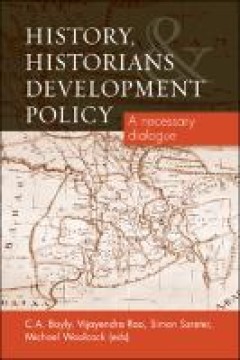
History, historians and development policy: a necessary dialogue
The substantive and methodological contributions of professional historians to development policy debates was marginal, whether because of the dominance of economists or the inability of historians to contribute. There are broadly three ways in which history matters for development policy. These include insistence on the methodological principles of respect for context, process and difference; …
- Edition
- -
- ISBN/ISSN
- 9781526151612
- Collation
- xii, 276 p. : ill.
- Series Title
- -
- Call Number
- 320.6 RAO h
 Computer Science, Information & General Works
  Philosophy & Psychology
  Religion
  Social Sciences
  Language
  Pure Science
  Applied Sciences
  Art & Recreation
  Literature
  History & Geography