Filter by
Found 1 from your keywords: author=Bozic, Mirjana
# Debug Box
/var/www/htdocs/pustaka-digital/lib/SearchEngine/SearchBiblioEngine.php:688 "Search Engine Debug 🔎 🪲"
Engine Type ⚙️: "SLiMS\SearchEngine\SearchBiblioEngine"
SQL ⚙️: array:2 [
  "count" => "select count(sb.biblio_id) from search_biblio as sb where sb.opac_hide=0 and ((match (sb.author) against (:author in boolean mode)))"
  "query" => "select sb.biblio_id, sb.title, sb.author, sb.topic, sb.image, sb.isbn_issn, sb.publisher, sb.publish_place, sb.publish_year, sb.labels, sb.input_date, sb.edition, sb.collation, sb.series_title, sb.call_number from search_biblio as sb where sb.opac_hide=0 and ((match (sb.author) against (:author in boolean mode))) order by sb.last_update desc limit 10 offset 0"
]
Bind Value ⚒️: array:1 [
  ":author" => "'+Bozic, Mirjana'"
]
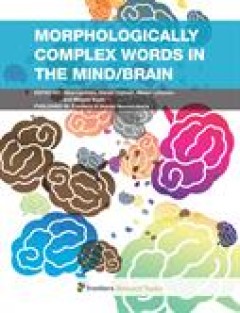
Morphologically complex words in the mind/brain
The question of how morphologically complex words (assign-ment, listen-ed) are represented and processed in the brain has been one of the most hotly debated topics in the cognitive neuroscience of language. Do complex words engage cortical representations and processes equivalent to single lexical objects or are they processed as sequences of separate morpheme-like units? Research on morphologi…
- Edition
- -
- ISBN/ISSN
- 9782889198030
- Collation
- 230 p.; 22 cm.
- Series Title
- Frontiers Research Topics
- Call Number
- 425 MOR m
 Computer Science, Information & General Works
  Philosophy & Psychology
  Religion
  Social Sciences
  Language
  Pure Science
  Applied Sciences
  Art & Recreation
  Literature
  History & Geography