Filter by
# Debug Box
/var/www/htdocs/pustaka-digital/lib/SearchEngine/SearchBiblioEngine.php:688 "Search Engine Debug 🔎 🪲"
Engine Type ⚙️: "SLiMS\SearchEngine\SearchBiblioEngine"
SQL ⚙️: array:2 [
  "count" => "select count(sb.biblio_id) from search_biblio as sb where sb.opac_hide=0 and ((match (sb.author) against (:author in boolean mode)))"
  "query" => "select sb.biblio_id, sb.title, sb.author, sb.topic, sb.image, sb.isbn_issn, sb.publisher, sb.publish_place, sb.publish_year, sb.labels, sb.input_date, sb.edition, sb.collation, sb.series_title, sb.call_number from search_biblio as sb where sb.opac_hide=0 and ((match (sb.author) against (:author in boolean mode))) order by sb.last_update desc limit 10 offset 0"
]
Bind Value ⚒️: array:1 [
  ":author" => "'+Forberg, Corinna'"
]
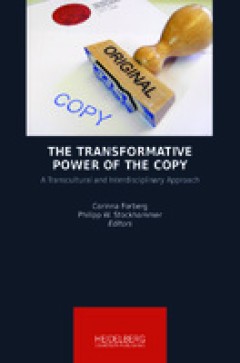
The transformative power of the copy : a transcultural and interdisciplinary …
This volume offers a fresh perspective on the copy and the practice of copying, two topics that, while the focus of much academic discussion in recent decades, have been underrepresented in the discourse on transculturality. Here, experts from a wide range of academic disciplines present their views on the copy from a transcultural perspective, seeking not to define the copy uniformly, but to r…
- Edition
- -
- ISBN/ISSN
- 9783946054153
- Collation
- VI, 407 p.
- Series Title
- Heidelberg Studies on Transculturality
- Call Number
- 300 FOR t

A typology of marked-S languages
Case-systems all over the world exhibit striking similarities. In most lan- guages intransitive subjects (S) receives less overt marking than one of the two transitive arguments (agent-like A or patient-like P); the other one of these two arguments is usually encoded by the same form as S. In some languages the amount of overt marking is identical between S, A, and P. But hardly ever does the S…
- Edition
- -
- ISBN/ISSN
- 9783944675190
- Collation
- XIII, 263 p.
- Series Title
- Studies in Diversity Linguistics
- Call Number
- 415 HAN t
 Computer Science, Information & General Works
  Philosophy & Psychology
  Religion
  Social Sciences
  Language
  Pure Science
  Applied Sciences
  Art & Recreation
  Literature
  History & Geography