Filter by
Found 1 from your keywords: author=Keong
# Debug Box
/var/www/htdocs/pustaka-digital/lib/SearchEngine/SearchBiblioEngine.php:688 "Search Engine Debug 🔎 🪲"
Engine Type ⚙️: "SLiMS\SearchEngine\SearchBiblioEngine"
SQL ⚙️: array:2 [
  "count" => "select count(sb.biblio_id) from search_biblio as sb where sb.opac_hide=0 and ((match (sb.author) against (:author in boolean mode)))"
  "query" => "select sb.biblio_id, sb.title, sb.author, sb.topic, sb.image, sb.isbn_issn, sb.publisher, sb.publish_place, sb.publish_year, sb.labels, sb.input_date, sb.edition, sb.collation, sb.series_title, sb.call_number from search_biblio as sb where sb.opac_hide=0 and ((match (sb.author) against (:author in boolean mode))) order by sb.last_update desc limit 10 offset 0"
]
Bind Value ⚒️: array:1 [
  ":author" => "'+Keong'"
]
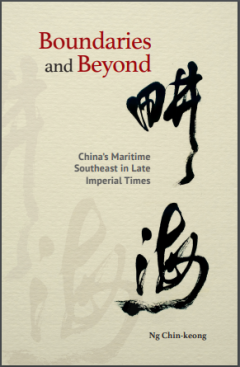
Boundaries and beyond: China's maritime Southeast in late imperial times
Using the concept of boundaries, physical and cultural, to understand the development of China’s maritime southeast in late Imperial times, these linked essays by a senior scholar challenge the usual readings of Chinese history from the centre. The book begins with the boundaries between “us” and “them”, Chinese and other, during this period, including the rise of state systems. It lo…
- Edition
- -
- ISBN/ISSN
- 9789814722018
- Collation
- xiv, 499 pages, 3 pages of plates : maps ; 24 cm
- Series Title
- -
- Call Number
- 382.0910903
 Computer Science, Information & General Works
  Philosophy & Psychology
  Religion
  Social Sciences
  Language
  Pure Science
  Applied Sciences
  Art & Recreation
  Literature
  History & Geography