Filter by
Found 1 from your keywords: author=Oguamanam, Chidi
# Debug Box
/var/www/htdocs/pustaka-digital/lib/SearchEngine/SearchBiblioEngine.php:688 "Search Engine Debug 🔎 🪲"
Engine Type ⚙️: "SLiMS\SearchEngine\SearchBiblioEngine"
SQL ⚙️: array:2 [
  "count" => "select count(sb.biblio_id) from search_biblio as sb where sb.opac_hide=0 and ((match (sb.author) against (:author in boolean mode)))"
  "query" => "select sb.biblio_id, sb.title, sb.author, sb.topic, sb.image, sb.isbn_issn, sb.publisher, sb.publish_place, sb.publish_year, sb.labels, sb.input_date, sb.edition, sb.collation, sb.series_title, sb.call_number from search_biblio as sb where sb.opac_hide=0 and ((match (sb.author) against (:author in boolean mode))) order by sb.last_update desc limit 10 offset 0"
]
Bind Value ⚒️: array:1 [
  ":author" => "'+Oguamanam, Chidi'"
]
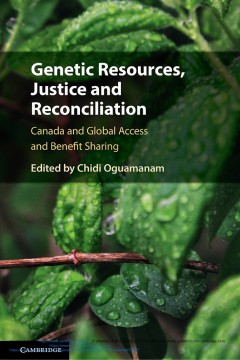
Genetic resources, justice and reconciliation : Canada and global access and …
When the oral history of a medicinal plant as a genetic resource is used to develop a blockbuster drug, how is the contribution of indigenous peoples recognized in research and commercialization? What other ethical, legal, and policy issues come into play? Is it accurate for countries to self-identify as users or providers of genetic resources? This edited collection, which focuses on Canada, i…
- Edition
- -
- ISBN/ISSN
- 9781108557122
- Collation
- xix, 279p. : ill.
- Series Title
- -
- Call Number
- 346.710469534 GEN g
 Computer Science, Information & General Works
  Philosophy & Psychology
  Religion
  Social Sciences
  Language
  Pure Science
  Applied Sciences
  Art & Recreation
  Literature
  History & Geography