Filter by
Found 1 from your keywords: author=Sikand, Yoginder
# Debug Box
/var/www/htdocs/pustaka-digital/lib/SearchEngine/SearchBiblioEngine.php:688 "Search Engine Debug 🔎 🪲"
Engine Type ⚙️: "SLiMS\SearchEngine\SearchBiblioEngine"
SQL ⚙️: array:2 [
  "count" => "select count(sb.biblio_id) from search_biblio as sb where sb.opac_hide=0 and ((match (sb.author) against (:author in boolean mode)))"
  "query" => "select sb.biblio_id, sb.title, sb.author, sb.topic, sb.image, sb.isbn_issn, sb.publisher, sb.publish_place, sb.publish_year, sb.labels, sb.input_date, sb.edition, sb.collation, sb.series_title, sb.call_number from search_biblio as sb where sb.opac_hide=0 and ((match (sb.author) against (:author in boolean mode))) order by sb.last_update desc limit 10 offset 0"
]
Bind Value ⚒️: array:1 [
  ":author" => "'+Sikand, Yoginder'"
]
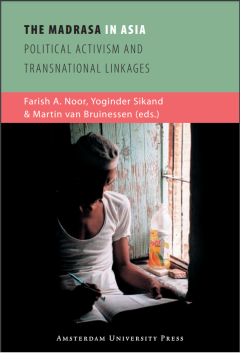
Madrasa in Asia: political activism and transnational linkages
Since the rise of the Taliban and Al Qaeda, the traditional Islamic schools known as the madrasa have frequently been portrayed as hotbeds of terrorism. For much longer, the madrasa has been considered by some as a backward and petrified impediment to social progress. However, for an important segment of the poor Muslim populations of Asia, madrasas constitute the only accessible form of educat…
- Edition
- -
- ISBN/ISSN
- 9789048501380
- Collation
- 303 p. : maps ; 24 cm.
- Series Title
- ISIM series on contemporary Muslim societies
- Call Number
- 370.95 MAD m
 Computer Science, Information & General Works
  Philosophy & Psychology
  Religion
  Social Sciences
  Language
  Pure Science
  Applied Sciences
  Art & Recreation
  Literature
  History & Geography