Filter by
# Debug Box
/var/www/htdocs/pustaka-digital/lib/SearchEngine/SearchBiblioEngine.php:688 "Search Engine Debug 🔎 🪲"
Engine Type ⚙️: "SLiMS\SearchEngine\SearchBiblioEngine"
SQL ⚙️: array:2 [
  "count" => "select count(sb.biblio_id) from search_biblio as sb where sb.opac_hide=0 and ((match (sb.author) against (:author in boolean mode)))"
  "query" => "select sb.biblio_id, sb.title, sb.author, sb.topic, sb.image, sb.isbn_issn, sb.publisher, sb.publish_place, sb.publish_year, sb.labels, sb.input_date, sb.edition, sb.collation, sb.series_title, sb.call_number from search_biblio as sb where sb.opac_hide=0 and ((match (sb.author) against (:author in boolean mode))) order by sb.last_update desc limit 10 offset 0"
]
Bind Value ⚒️: array:1 [
  ":author" => "'+Hansson, Ulf R.'"
]

Movement of knowledge : medical humanities perspectives on medicine, science,…
Medical knowledge is always in motion. It moves from the lab to the office, from a press release to a patient, from an academic journal to a civil servant’s desk and then on to a policymaker. Knowledge is deconstructed, reconstructed, and transformed as it moves. The dynamic, ever-evolving nature of medical knowledge has given rise to different concepts to explain it: diffusion, translation, …
- Edition
- -
- ISBN/ISSN
- 9789188909367
- Collation
- 261 p.
- Series Title
- -
- Call Number
- 610.1 HAN m

Deliberation, representation, equity: research approaches, tools and algorith…
What can we learn about the development of public interaction in e-democracy from a drama delivered by mobile headphones to an audience standing around a shopping center in a Stockholm suburb? In democratic societies there is widespread acknowledgment of the need to incorporate citizens’ input in decision-making processes in more or less structured ways. But participatory decision making is …
- Edition
- -
- ISBN/ISSN
- 9781783743056
- Collation
- 376 p. : ill. : ind. ; 24 cm
- Series Title
- -
- Call Number
- 323.042 DEL d
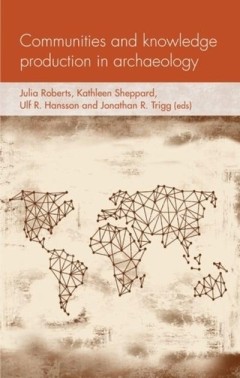
Communities and knowledge production in archaeology
The dynamic processes of knowledge production in archaeology and elsewhere in the humanities and social sciences are increasingly viewed as the collaborative effort of groups, clusters and communities of researchers rather than the isolated work of so-called ‘instrumental’ actors. Shifting focus from the individual scholar to the wider social contexts of her work and the dynamic creative pr…
- Edition
- -
- ISBN/ISSN
- 9781526134554
- Collation
- xvii, 250p. : ill.
- Series Title
- -
- Call Number
- 930.1 COM c
 Computer Science, Information & General Works
  Philosophy & Psychology
  Religion
  Social Sciences
  Language
  Pure Science
  Applied Sciences
  Art & Recreation
  Literature
  History & Geography