Filter by
# Debug Box
/var/www/htdocs/pustaka-digital/lib/SearchEngine/SearchBiblioEngine.php:688 "Search Engine Debug 🔎 🪲"
Engine Type ⚙️: "SLiMS\SearchEngine\SearchBiblioEngine"
SQL ⚙️: array:2 [
  "count" => "select count(sb.biblio_id) from search_biblio as sb where sb.opac_hide=0 and ((match (sb.author) against (:author in boolean mode)))"
  "query" => "select sb.biblio_id, sb.title, sb.author, sb.topic, sb.image, sb.isbn_issn, sb.publisher, sb.publish_place, sb.publish_year, sb.labels, sb.input_date, sb.edition, sb.collation, sb.series_title, sb.call_number from search_biblio as sb where sb.opac_hide=0 and ((match (sb.author) against (:author in boolean mode))) order by sb.last_update desc limit 10 offset 0"
]
Bind Value ⚒️: array:1 [
  ":author" => "'+Pillath, Carsten'"
]
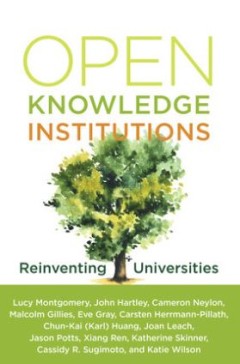
Open knowledge institutions: reinventing universities
In this book, a diverse group of authors—including open access pioneers, science communicators, scholars, researchers, and university administrators—offer a bold proposition: universities should become open knowledge institutions, acting with principles of openness at their center and working across boundaries and with broad communities to generate shared knowledge resources for the benefit…
- Edition
- -
- ISBN/ISSN
- 9780262365154
- Collation
- xi, 177 p. : ill
- Series Title
- -
- Call Number
- 378.101 MON o
Artificial Intelligence for a Better Future : An Ecosystem Perspective on the…
This open access book proposes a novel approach to Artificial Intelligence (AI) ethics. AI offers many advantages: better and faster medical diagnoses, improved business processes and efficiency, and the automation of boring work. But undesirable and ethically problematic consequences are possible too: biases and discrimination, breaches of privacy and security, and societal distortions such as…
- Edition
- -
- ISBN/ISSN
- 9783030699789
- Collation
- 124 p
- Series Title
- SpringerBriefs in Research and Innovation Governance,
- Call Number
- 174.90063 STA
Narratives and comparisons : adversaries or allies in understanding science?
As a powerful tool in the production of knowledge, comparing plays a crucial part in the sciences and the humanities. This volume explores the relationship between comparing and narrating in epistemic practices and clarifies the ways in which narratives enable or impede practices of comparing. It takes into account related activities, such as measuring and classifying, modeling, establishing no…
- Edition
- -
- ISBN/ISSN
- 9783839454152
- Collation
- 202 p.
- Series Title
- -
- Call Number
- 501 NAR n

Artificial intelligence for a better future : an ecosystem perspective on the…
This open access book proposes a novel approach to Artificial Intelligence (AI) ethics. AI offers many advantages: better and faster medical diagnoses, improved business processes and efficiency, and the automation of boring work. But undesirable and ethically problematic consequences are possible too: biases and discrimination, breaches of privacy and security, and societal distortions such as…
- Edition
- -
- ISBN/ISSN
- 9783030699789
- Collation
- x, 124p. : ill.
- Series Title
- -
- Call Number
- 174.90063 STA a

E-science : open, social and virtual technology for research collaboration
This open access book shows the breadth and various facets of e-Science, while also illustrating their shared core. Changes in scientific work are driven by the shift to grid-based worlds, the use of information and communication systems, and the existential infrastructure, which includes global collaboration. In this context, the book addresses emerging issues such as open access, collaborati…
- Edition
- -
- ISBN/ISSN
- 9783030662622
- Collation
- xii, 185p. : ill.
- Series Title
- -
- Call Number
- 507.2 ELE e

Cross-border dissemination of online content
Can the rules of the European Union’s E-Commerce Directive, which date back to the year 2000, continue to be valid with regard to the dissemination of content in view of the constantly evolving online environment and the changing role of platforms as a result of new business models?The relevant legal foundations in this respect at EU and national level are complex, and their interplay is ofte…
- Edition
- -
- ISBN/ISSN
- 9783748906438
- Collation
- 81 p.
- Series Title
- -
- Call Number
- 004.6 COL c

Spationomy : spatial exploration of economic data and methods of interdiscipl…
This open access book is based on "Spationomy – Spatial Exploration of Economic Data", an interdisciplinary and international project in the frame of ERASMUS+ funded by the European Union. The project aims to exchange interdisciplinary knowledge in the fields of economics and geomatics. For the newly introduced courses, interdisciplinary learning materials have been developed by a team of…
- Edition
- -
- ISBN/ISSN
- 9783030266264
- Collation
- viii, 325p. : ill.
- Series Title
- -
- Call Number
- 330.9 SPA s
 Computer Science, Information & General Works
  Philosophy & Psychology
  Religion
  Social Sciences
  Language
  Pure Science
  Applied Sciences
  Art & Recreation
  Literature
  History & Geography